What is speed networking? How it works and why it works
Speed networking is one of the simplest ways to get a room of strangers talking. Instead of hoping people find each other over coffee, the host pairs them up for short, timed one-to-one chats and moves everyone to a new partner when the time is up.
This guide explains what speed networking is, where the format came from, how a session runs in person and online, the rules guests follow, why it works and when it's the right choice for your group. If you already know you want to run one, our guide to running an online speed networking event picks up where this one leaves off.
The short answer
Speed networking is an event format where guests meet one person at a time for a few minutes, then move to a new partner when the host calls time. A session usually runs for about an hour, with a short welcome, a series of timed rounds and a closing wrap-up. It works in a room or on video, and it gives every guest a fair chance to meet new people, which open mingling often doesn't.
Key takeaways
- It's timed and one-to-one. Guests talk to one person for a few minutes, then everyone moves on at the same moment.
- The host does the hard part. Nobody has to approach a stranger or find a polite way out of a chat.
- It grew out of speed dating. Business groups borrowed the format in the early 2000s, and it now runs everywhere from chambers of commerce to career fairs.
- There are many variations. Two-sided rounds, small tables, topic tables and matching all build on the same simple idea.
- It works online too. Video rounds remove the travel, and the platform can handle the timing and pairing for you.
What speed networking means
Speed networking is a meeting format built for one job: helping people make a lot of useful first contacts in a short time. A host pairs guests up and starts a timer, and when the time runs out, everyone switches to someone new. The Wikipedia entry on speed networking describes it as a format designed to accelerate business contacts, which is exactly how most organizers use it.
Four things make an event speed networking rather than a regular mixer:
- Short rounds. Each chat lasts a set time, usually somewhere between 4 and 10 minutes.
- One partner at a time. Most rounds are one-to-one, so both people get to talk and listen.
- Rotation. Everyone moves on at the same moment, to someone they haven't met yet.
- A host. Someone keeps time, explains the rules and makes sure nobody is left out.
Where the format came from
Speed networking borrows its shape from speed dating, the round-robin format for meeting potential partners that appeared in the late 1990s. Business groups saw that the same structure could fix a familiar problem at networking events: people stick with who they already know. According to the same Wikipedia entry, speed networking was first used in the early 2000s and grew in popularity by the end of that decade.
Today you'll find it at chambers of commerce, alumni associations, membership drives, career fairs, mentoring programs and large events where many organizations gather. The details change from one group to the next, but the core idea stays the same: short, fair, structured chats with a new person each time.
How a speed networking session runs
Every speed networking event, in a room or on video, follows the same basic shape: a welcome, a set of timed rounds and a wrap-up. What changes is how people get from one partner to the next.
In person
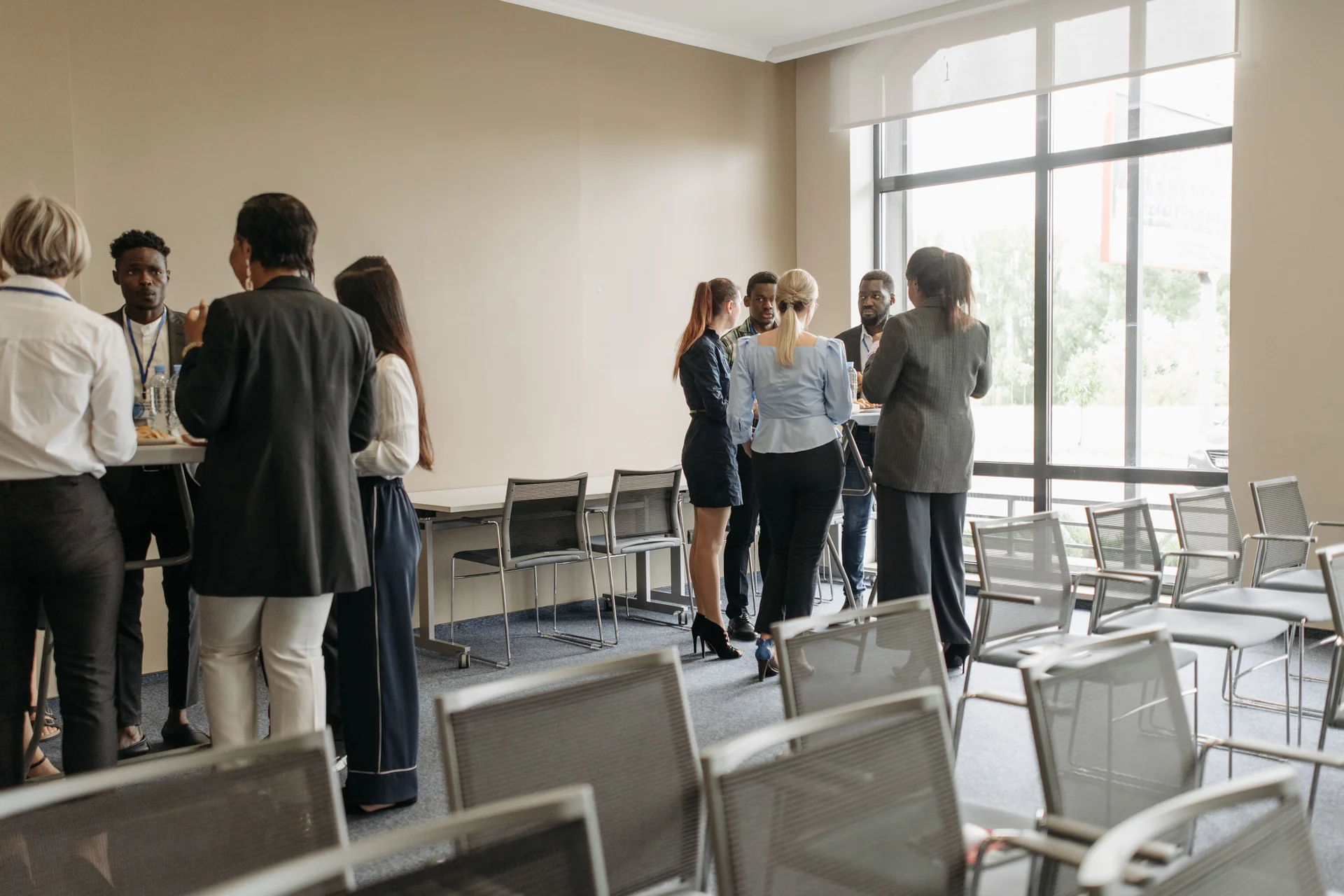
In a room, the host usually sets out two lines of chairs facing each other, or an inner and an outer circle. When a round ends, one side moves along one seat and the other side stays put. Some events use small numbered tables instead, with guests moving between them. A bell, a chime or a voice on the microphone marks each switch, and name tags make it easier to remember who you met.
Online
Online, there are no chairs to move. Guests join from a link, gather in a welcome room with the host, and are then placed in private video rooms with one partner. When the timer ends, the platform moves everyone to a new room with a new partner. The host stays in control the whole time: watching the clock, sending messages to everyone and stepping in if a room needs help. At the end, everyone comes back together for a short closing room.
What a guest experiences, step by step
- Arrive and check in. Guests sign in at the door or join from a link, ideally a few minutes early.
- Hear the welcome. The host explains how the rounds work, how long each one lasts and what happens at the end.
- Meet the first partner. A quick hello, names and a sentence each on what you do.
- Talk about something useful. A shared interest, a question, an ask or an offer. A prompt on the table or on screen helps here.
- Get a warning. About a minute before the switch, a signal tells people to wrap up and swap details.
- Move on. Everyone switches at the same time, and the next round starts.
- Wrap up together. The closing gives people a moment to share what they enjoyed and hear what comes next.
The same Wikipedia entry notes that a round-robin event of about an hour gives each guest roughly 10 new contacts. The exact number depends on how long you make each round and how much time you give the welcome and closing, which we cover in our guide to how long speed networking rounds should be.
The rules guests follow
Speed networking works because everyone follows the same few rules. Hosts usually read them out in the welcome, and many put them on a slide or a card so guests can glance back at them.
- Share the time. Each person gets about half the round. If you've been talking for a while, ask a question and listen.
- Start with who you are and why you came. One or two sentences is plenty. Save the full story for the follow-up.
- Move when the host says move. Even if the chat is going well. You can always pick it up again later.
- Skip the hard sell. A pitch in the first minute makes people wish the round were shorter.
- Agree on a next step. If you'd like to stay in touch, say so and swap details before the switch.
- Be kind to quiet partners. Some people need a minute to warm up. A good question helps more than a long introduction.
Tip: In the invite, ask guests to prepare a one-line introduction: who they are and one thing they're looking for. It makes the first minute of every round easier, especially for people who find networking awkward.
For conversation starters that fit each moment of a round, see our list of speed networking questions that get people talking.
Why short, timed chats work
Plenty of people dread networking. In a Harvard Business Review article on learning to love networking, researchers Francesca Gino, Maryam Kouchaki and Tiziana Casciaro write that executives, professionals and students often tell them networking makes them feel uncomfortable and phony. Speed networking takes away many of the moments that cause that feeling.
Nobody has to approach a stranger
At an open mixer, the hardest part is walking up to someone you don't know. In speed networking, the host makes every introduction. You never have to decide who to talk to next, or wonder whether someone wants to talk to you.
Nobody gets stuck
The second hardest part of a mixer is leaving a conversation politely. Here, the timer does it for you. A chat that isn't going anywhere ends in a few minutes anyway, and a great one ends on a high note, with a reason to follow up.
Everyone gets a fair turn
Open mingling rewards the confident. People who already know each other tend to cluster together, while newcomers hover at the edges. Rotation gives every guest the same number of chats and the same share of attention, whether they're the most senior person in the room or it's their first event.
More chances to meet the right person
At a mixer, many people spend most of the evening with whoever they arrived with or met first. Speed networking puts each guest in front of many more people in the same hour, which raises the chance of meeting someone who can genuinely help them, or who needs exactly what they offer.
The timer does the two hardest jobs in networking: starting a conversation and ending one.
The same HBR authors suggest that networking feels more authentic when you think about how your goals line up with the other person's, and when you remember that you have something valuable to offer. A short, structured chat with a good prompt nudges people in exactly that direction.
Who uses speed networking
Any group that wants its people to meet each other can use the format. These are the groups that use it most often:
Member communities
Regulars meet newcomers, and everyone leaves with a few names to follow up with.
Accelerators and incubators
Founders get focused time with mentors, investors or the peers who can help them most.
Chambers and associations
Members meet other members they could do business with, refer or partner with.
Conferences and summits
A networking session that fits between talks and gives attendees people to look for later.
Universities and alumni
Students and graduates meet across years and fields at career nights.
Teams inside companies
New hires and colleagues from different departments get to know each other.
Mentoring programs use it too, to let mentors and mentees meet several possible matches before the pairs are set. The use cases page has a suggested setup for each of these groups.

Common formats and variations
The classic version pairs everyone with a new partner each round. Over the years, organizers have added variations to suit different goals:
| Format | How it works | Best for |
|---|---|---|
| Rotating one-to-one | A new partner every round, avoiding repeats | General networking and mixers |
| Two-sided rounds | Guests pick a side and only meet people from the other side | Mentoring, founders meeting investors, hiring |
| Small tables | Groups of 3 to 6 instead of pairs, shuffled each round | Gentle starts, team events, longer chats |
| Topic tables | The host sets topics and each guest picks a table | Conferences with tracks, interest groups |
| Matched rounds | Short questions at sign-up help pair people who can help each other | Large groups where nobody can meet everyone |
Most events mix two or three of these. A common pattern is a few one-to-one rounds, then a small-table round in the middle to lift the energy. On SpeedHuddle, a new partner every round is the default, small tables, topic tables and two-sided rounds are settings you switch on, and guests can answer optional matching questions when they join. The pairing and matching features show how each one works.
Good to know: Odd numbers are normal. With an odd number of guests, one pair becomes a trio for that round, or the host joins the extra person. Say so in the welcome, so nobody feels left out when it happens.
Speed networking compared with other formats
Speed networking isn't the only way to help people meet. Here's how it compares with the formats it's most often weighed against:
| Format | What it's like | Strengths | Trade-offs |
|---|---|---|---|
| Open mingling | Guests find each other on their own | Relaxed, flexible, no setup | Newcomers struggle, and people cluster with friends |
| Roundtable discussions | Small groups talk through a set topic | Deeper talk and shared learning | Fewer new contacts, and a few voices can dominate |
| One-to-one coffee chats | Two people meet for 20 to 30 minutes | Real depth | Meeting many people takes weeks |
| Speed networking | Timed one-to-one rounds with rotation | Many new contacts, fair for everyone, easy for shy guests | Each chat is short, so the follow-up matters |
No format is best in every case. Speed networking shines when the goal is to help people meet many new people quickly and fairly. If your group already knows each other well, or you want long discussions, a roundtable or a coffee-chat series may fit better. Many hosts combine them: speed networking to break the ice, then open time so people can continue the chats they enjoyed.
Online or in person?
The format works in both places, and each has its own strengths.
Why run it in person
- The energy of a full room, plus food, drinks and body language that's easy to read.
- Guests who live nearby can easily meet again.
- People often linger after the rounds, which turns first chats into longer ones.
Why run it online
- No travel, so people can join from anywhere, even in a lunch break.
- The platform handles the timing, pairing and room changes, so every switch is instant and fair.
- Matching questions, conversation prompts and a list of who you met are easy to add.
- Guests in different cities, provinces or countries can meet without a plane ticket.
Online events need a little extra care. A new face every few minutes can feel tiring, so keep the number of rounds sensible, and put a question on screen so nobody spends the first minute wondering what to say. To see what it feels like as a guest, try the sample event in your browser.
Tip: In the reminder email, ask guests to join from a quiet spot, keep their camera on and test their camera and microphone before the start. A three-line checklist saves the first round from technical trouble.
When it works best, and when it doesn't
Speed networking is a great fit when:
- Many guests don't know each other. New members, a new cohort, or a mixed crowd from different organizations.
- You want everyone to meet more than a couple of people. Rotation makes sure they do.
- The group shares a clear reason to meet. A profession, a program, an industry or a goal.
- Some guests are shy or new. Structure helps them more than anyone.
- You need specific matches. Mentors and mentees, founders and investors, employers and candidates.
It's a weaker fit when:
- The group is small and already close. People who know each other well may prefer open time or a discussion.
- The main goal is learning. If guests came for a speaker or a workshop, keep the networking short and put it at the end.
- Guests can only stay a few minutes. Rotation needs everyone present for most of the rounds.
Watch out: Short rounds create first contacts, not relationships. If nobody follows up, the best chats fade within days. Plan the follow-up before the event: a thank-you message, a reminder to reach out and the date of the next event.
Common myths about speed networking
"It's just speed dating for business"
The format is borrowed, but the goal is different. Nobody is choosing a partner. Guests are meeting people who might become clients, collaborators, mentors, friends or a useful introduction later on.
"It's only for extroverts"
Quieter people often prefer it. They don't have to break into a group or start a chat from nothing, and a prompt gives them an easy way in. It's sometimes the loudest people in the room who find the timer frustrating.
"You can't say anything useful in a few minutes"
You can't say everything, and you don't need to. A good round has one goal, and it's a simple one.
A good round has one job: to find out whether a second conversation is worth having.
That takes less time than most people expect, and the follow-up is where the real conversation happens.
"It only works for big groups"
A group of ten can do it, and in a group that small everyone may meet everyone. Larger groups need matching or two-sided rounds, so the chats people do have are more likely to count.
How to try speed networking
If you're thinking about running your first event, start small and keep it simple:
- Pick one goal. Write down who is coming and what they should leave with.
- Choose the length. A 10-minute welcome, six rounds of 6 minutes and a 10-minute closing make a 56-minute event.
- Prepare a question for each round. Open questions that lead somewhere useful work best.
- Explain the rules in the welcome. Short rounds, equal time, move at the signal.
- Follow up within a day. Remind people who they met and tell them when the next event is.
Our step-by-step guide to running an online speed networking event covers each of these in detail, from the invite to the follow-up. If you'd like to see what's included when the platform runs the rounds for you, start with how it works.
Run your first speed networking event
SpeedHuddle runs the timed part for you: the welcome room, the rounds with a one-minute warning, fair pairing and a list of who met whom at the end. Guests join from a link, with nothing to download.
Frequently asked questions
What is the purpose of speed networking?
The purpose is to help people make many useful first contacts in a short time. Instead of leaving introductions to chance, the host pairs guests for short timed chats and rotates them, so everyone meets several new people and can decide who to follow up with.
How long is each speed networking round?
Most rounds last between 4 and 10 minutes. Around 6 minutes suits general networking, while mentoring and investor chats often need 8 to 10. Small group tables need longer rounds, because more people share the time.
How many people do you need for speed networking?
You can run it with a group of about ten, and in a group that size everyone may meet everyone. There's no real upper limit, but in large groups nobody can meet everyone, so matching questions or two-sided rounds help each chat count.
What do you say at a speed networking event?
Start with your name, what you do and why you came, in a sentence or two. Then ask an open question, such as what the other person is working on or who would be a useful introduction for them. Before the switch, decide together whether to stay in touch.
Is speed networking the same as speed dating?
No. Speed networking borrows the timed, rotating format of speed dating, but the goal is professional. Guests are meeting potential clients, collaborators, mentors and peers, not looking for a romantic match.
Can you do speed networking online?
Yes. Online speed networking uses a private video room for each pair and moves everyone to a new partner when the timer ends. It removes travel and lets the platform handle the timing and pairing, while the host welcomes everyone and wraps up at the end.
How do you prepare for a speed networking event?
Have a one-line introduction ready, think of one thing you're looking for and one thing you can offer, and decide how you'll share your contact details. If the event is online, test your camera and microphone and join from a quiet place.
What happens after a speed networking event?
The value comes from the follow-up. Good hosts send a thank-you message with a reminder to reach out, and many platforms give guests a list of the people they met. Send a short note to the people you'd like to see again within a day or two.